Session 4
An LED Quiz Board
We built quiz boards from scratch. A green LED for a right answer, a red one for a wrong one, and a lesson about what happens when being wrong stops being embarrassing.
- Date
- Place
- Skill Hub
- Topic
- Circuits
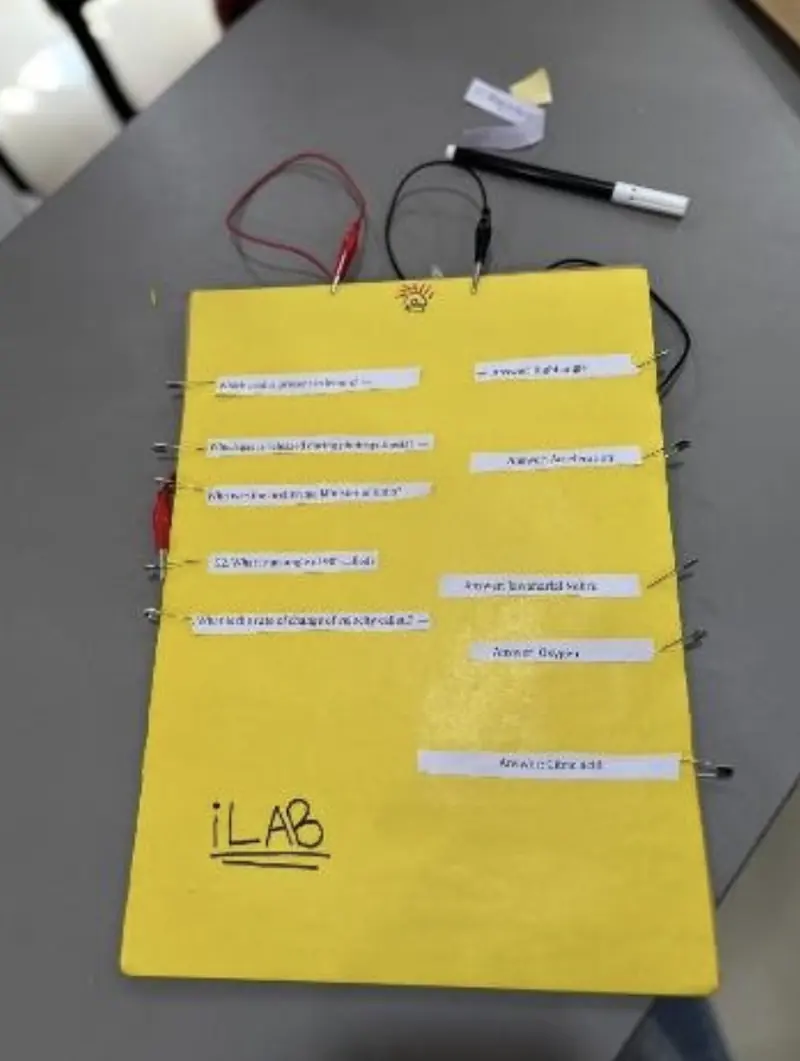
A quiz board is a simple idea. Questions on one side, answers on the other, a wire you touch from one to the next. Get it right and a green LED lights up. Get it wrong and you see red.
No kits this time. Wires, batteries, LEDs, and a board to build it all on.
What I didn't expect was how much the board would change the way students treated mistakes. On paper, a wrong answer sits there until someone marks it. Here, red shows up instantly, costs nothing, and you just try again. Being wrong became fast and a little bit funny.
The same thing happened with the wiring itself. A board that lit red for a right answer meant something was crossed. A board that lit nothing meant an open circuit. A battery getting warm meant a short. Every fault had its own symptom, and students learned to read them like clues.

Here's what stayed with me. The board doesn't actually know anything. It only knows what its builder wired into it. If you connect the wrong answer to green, the board will tell everyone that answer is correct, confidently, forever.
That's true of a lot of things that look like they know the answer.
The best moments were students fixing each other's boards. Someone would lean over, follow a wire with a finger, and find the crossed connection. Nobody asked them to. Once mistakes stop being embarrassing, helping is just what people do.