Session 7
A Touchless Water Dispenser
Thirteen students built a touchless water dispenser from an IR sensor, a transistor and a DC pump. The first build in the programme that does something genuinely useful.
- Date
- Place
- Skill Hub
- Topic
- Automation
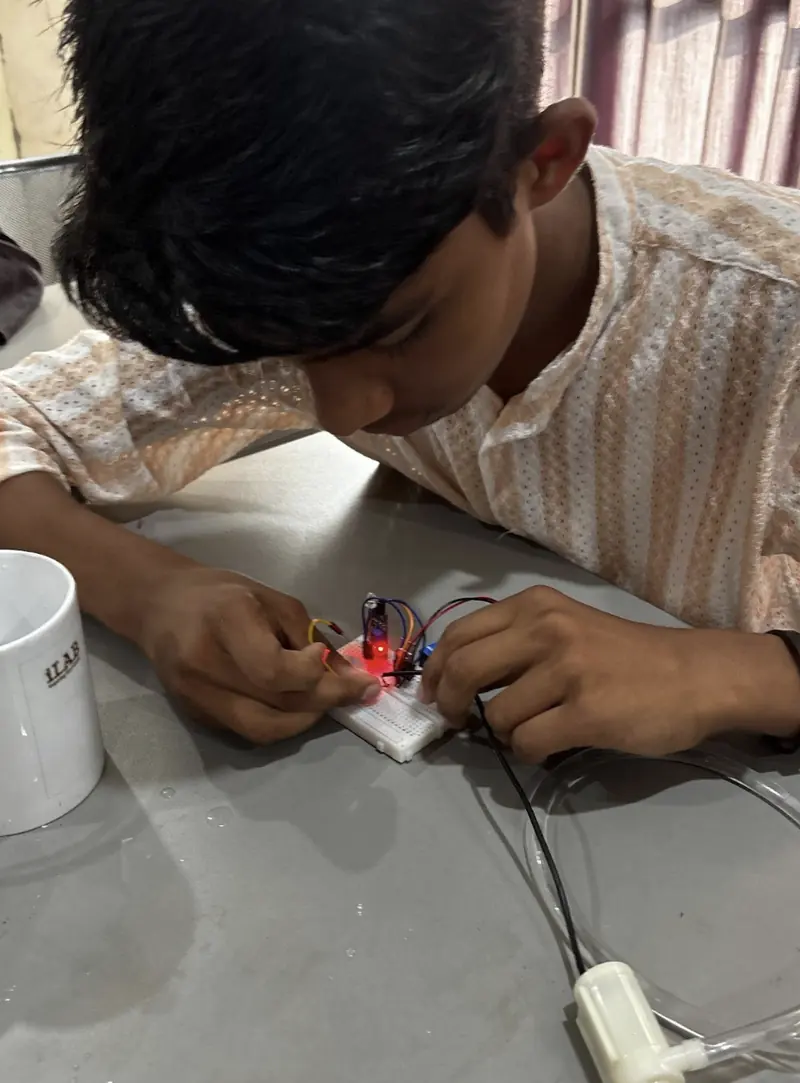
Everything we'd built so far lit something up or made a sound. This time, the circuit had to move water.
The idea is the one inside touchless dispensers in hospitals and public washrooms. An IR sensor sees a hand. A transistor switches on. A DC pump starts running. Take the hand away and it stops.
The transistor is the real hero here. The sensor's signal is tiny, far too weak to run a pump on its own. The transistor lets that small signal control a much bigger current. A whisper opening a gate.
I love that idea. So much of the world works like this. A small signal, a switch, and something heavy moves. A finger on a button starts a lift. A word starts a meeting. Leverage, in electronic form.
Thirteen students built the whole thing: sensor, transistor, pump, power. Then came testing, waving a hand at different distances to find where the sensor starts to care. Then troubleshooting together when the pump stayed still.
When it worked, it really worked. Water moved because a hand came close. Of everything in the programme so far, that was the moment that landed hardest.
What pleased me most came afterwards. Students explained what each part was doing without being asked. The sensor notices, the transistor decides, the pump acts. Three roles, and once you can name them you can design a hundred other machines with the same shape.
It was also the first build with an obvious reason to exist. Less touching in places where touching spreads things. Something useful, from parts on a table.